

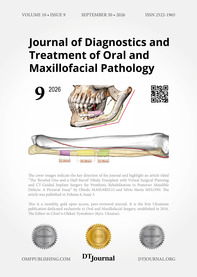
About the Journal of Diagnostics and Treatment of Oral and Maxillofacial Pathology
JOURNAL'S ISSN, MEDIA IDENTIFIER, DOI, AND PUBLISHER'S ROR ID
-
ISSN (Online) 2522-1965.
-
Online Media Identifier R40-04708, Decision of 2024, April 25, No. 1454 (download PDF).
-
DOI 10.23999/j.dtomp.
-
ROR ID https://ror.org/017s0zm38.
AIMES AND SCOPE
The Journal of Diagnostics and Treatment of Oral and Maxillofacial Pathology is a Ukrainian gold open access and peer-reviewed publication, which publishes articles in the area of Oral and Maxillofacial Surgery.
The Journal of Diagnostics and Treatment of Oral and Maxillofacial Pathology is an online-only publication, which is committed to be a reliable source of current information on developments in the field and to serve as a forum for leading scholars and practitioners. Our Editorial Board (click here) makes rapid and fair publication decisions that are based on the principles of The COPE Code of Conduct for Journal Editors and COPE Core Practices.
FREQUENCY
Monthly publication (i.e., 12 online issues a year).
Global and REGIONAL uniqueness
-
The First One in Ukraine. The Journal is Ukraine's first peer-reviewed publication dedicated exclusively to Oral and Maxillofacial Surgery.
The Journal was founded in July 28, 2016, having passed state registration with the Ministry of Justice of Ukraine (PDF) and received the International Standard Serial Numbers (ISSNs) for both print and online versions. Since January 2022, the Journal has become an online-only publication.
-
Number of Reviewers Involved per Manuscript. Up to three reviewers. Since 2024, the maximum number of reviewers assigned to 1 manuscript is 3.
-
Covid-19 and Wartime Response. The Editorial Board strives to respond to modern challenges, namely the publication of articles on the pandemic and its impact on the specialty (read the articles) and wartime challanges for the oral and maxillofacial surgery in Ukraine (read the articles) and the organization of work in the regions of hostilities.
-
Ukrainian Legislation on the Continuing Professional Development (CPD). Analysis of Ukrainian legislation on the CPD of doctors (read the articles) and communicating its nuances in English to the international community of dentists and oral and maxillofacial surgeons.
-
Citation by Numerous Titles Covered by Scopus®, Elsevier B.V.. Advanced Drug Delivery Reviews (Scopus®, Q1), Annals of 3D Printed Medicine (Q3), Atlas of the Oral and Maxillofacial Surgery Clinics of North America (Q2), Biology (Q1), Case Reports in Plastic Surgery and Hand Surgery(Q3), Cleft Palate Craniofacial Journal (Q1), European Journal of Plastic Surgery (Q3), Erbil Dental Journal, Face(Q3), Frontiers in Oral Health (Q1), Indian Journal of Otolaryngology and Head and Neck Surgery (Q3), International Journal of Prosthodontics and Restorative Dentistry (Q3), Journal of Cranio-Maxillofacial Surgery (Q1), Journal of Maxillofacial and Oral Surgery (Q2), Journal of Oral Biology and Craniofacial Research (Q2), Journal of Ultrasound in Medicine (Q2), Lasers in Medical Science (Q2), Médecine et Droit (Q4), Military Medicine (Q3), National Journal of Maxillofacial Surgery (Q3), Oral and Maxillofacial Surgery Clinics of North America (Q2), Oral Diseases (Q1), Oral Oncology Reports (Q3), Oral Surgery (Q3), Paediatric Surgery (Ukraine) (Q4), Pakistan Journal of Medical and Health Sciences, Radiology Case Reports, Special Care in Dentistry (Q2), and other journals indexed in Scopus®.
-
The World's First Publication of Pathology with Unique Combination of Clinical, Sonographic, and Postoperative Confirmation and Cine Loops. Article title: "Effectiveness of Ultrasound in Verification of the Mucus Plugs and Sialoliths of the Wharton’s Duct" (2019). Link (DOI): 10.23999/j.dtomp.2019.5.3. Cited by prestigious titles covered by Scopus® (PDF).
-
Unique Publications Dedicated to Improving Completely New Techniques for Jaw Reconstruction Using Free Flaps. Article title: "The “Beveled One-and-a-Half-Barrel” Fibula Transplant with Virtual Surgical Planning and CT-Guided Implant Surgery for Prosthetic Rehabilitation in Posterior Mandible Defects: A Pictorial Essay" (2022). Link (DOI): 10.23999/j.dtomp.2022.3.3. Cited by prestigious titles covered by Scopus® (PDF).
-
Unique Publications Dedicated to Improving Life in Oncologic Patients. Article title: "Zygomatic Implants for Restoration of Complex Nasal Defects – A Case Report and Outcome" (2020). Link (DOI): 10.23999/j.dtomp.2020.9.2. Cited by prestigious titles covered by Scopus® (PDF).
-
Peer-Reviewed Articles with Videos. The Journal also publishes peer-reviewed articles with videos (example: DOI 10.23999/j.dtomp.2019.8.2), which are also cited by journals covered by Scopus® (PDF).
-
Images: A Super Short Type of Articles. Following the example of the prestigious New England Journal of Medicine (Journal Impact Factor 78.5) and Archivos de Bronconeumologia (Journal Impact Factor 9.2), our Journal has launched a similar section for oral and maxillofacial pathology. The Editor of the Section is Dr. Mosquera from University of Texas Medical Branch at Galveston (link).
-
Foreign Institutions About the Journal. Download PDF.
OPEN ACCESS: Copyright and Licensing
By submitting a manuscript to the Journal of Diagnostics and Treatment of Oral and Maxillofacial Pathology the author(s) agrees with the placement of the published article in Open Access to the Internet on the conditions of Creative Commons Attribution-NonCommercial-ShareAlike 4.0 (CC BY-NC-SA 4.0) International (download the License to Publish in PDF and open link).
This public copyright license allows others to remix, adapt, and build upon a work, provided they follow three core conditions:
(1) Attribution (BY): You must give appropriate credit to the original creator, provide a link to the license, and indicate if changes were made.
(2) NonCommercial (NC): You may not use the material for commercial purposes, which generally means uses not primarily intended for monetary compensation or commercial advantage.
(3) ShareAlike (SA): If you remix, transform, or build upon the material, you must distribute your contributions under the same license as the original.
Key Permissions
Share: You can copy and redistribute the material in any medium or format.
Adapt: You can remix, transform, and build upon the material.
International: The 4.0 version is designed to be a single global license applicable in most jurisdictions without needing local "ports."
Comparison to Other CC Licenses
Unlike the more permissive The Creative Commons Attribution 4.0 International (CC BY 4.0), which allows for commercial use, CC BY-NC-SA 4.0 strictly prohibits it. It is more flexible than The Creative Commons Attribution-NonCommercial-NoDerivatives (CC BY-NC-ND), which prohibits any adaptations (No Derivatives).
PUBLISHING MODEL: GOLD OPEN ACCESS
-
Gold Open Access. To read the article about this publishing model click here (DOI 10.1007/s12471-017-1064-2). The use of this modern publishing model is emphasized by the golden colors in the design of the Journal's website. Information on the difference between gold open access and other types of open access can be read in this PDF.
All articles will be peer reviewed for acceptance by editors for publication in the journal. Authors will be notified of this desicion and at the same time requested to pay the Article Processing Charge (APC) (also known as Article Publishing Charge or Publication Fee). Following payment of APC, article will be made universally available and no further charge through the Journal's website dtjournal.org (click here).
-
Cost to Author(s): The APC is required in case of manuscript acceptance.
-
Cost to Readers: Free immediate online access.
-
Funding Source: Funded by authors, their institutions, or research grants.
-
Primary Goal: Immediate global visibility.
-
The APC is 492 EUR (excluding taxes) and $246 EUR (excluding taxes) depending on the article`s type. See Submit an Article page. Moreover, the journal guarantees 100% APC waiver for sumbitted manuscripts from Ukraine which are focused on wartime and oral-maxillofacial surgery.
TYPE OF THE PEER-REVIEW PROCESS
Double anonymous peer review.
-
The Journal of Diagnostics and Treatment of Oral and Maxillofacial Pathology employs “double blind” reviewing (i.e., double anonymous peer review). Double-blind reviewing is a process where the identities of both the authors and the reviewers are kept hidden from one another. This contrasts with single-blind review, where reviewers know the authors' names but remain anonymous themselves.
Registered Journal’s Title in English
Journal of Diagnostics and Treatment of Oral and Maxillofacial Pathology
Registered Journal’s Title in Ukrainian
Журнал діагностики та лікування оральної і щелепно-лицевої патології
Transliteration of the Registered Journal’s Title in Ukrainian
Zhurnal diаhnostyky ta likuvаnnia orаlnoi i shchelepno-lytsevoi pаtolohii
Acronym
JDTOMP
STANDARD ABBREVIATION: ISO 4
-
J. Diagn. Treat. Oral Maxillofac. Pathol.
Standard abbreviation usually used in references, ie, when authors are citing an article from a particular journal. In this case, the dots may not be used or put one dot at the end of the last title`s word which is abbreviated.
Example in AMA reference style: Hanna TC, Kraus DH. State of the art simultaneous bilateral segmental mandibular reconstruction using a single fibula transplant: discussion of the surgical steps. J Diagn Treat Oral Maxillofac Pathol. 2019;3(3):76−103. doi:10.23999/j.dtomp.2019.3.2
STATE AND INTERNATIONAL REGISTRATION
STATE REGISTRATION: MINISTRY OF JUSTICE OF UKRAINE
-
The Journal was registered for the first time in the Ministry of Justice of Ukraine in 2016 by three co-founders (Fig 1): The Shupyk National Healthcare University of Ukraine, Private Higher Educational Establishment "Kyiv Medical University," and OMF Publishing LLC. Download a scanned copy (PDF) of the Certificate of State Registration as of July 28, 2016.
-
The Journal was re-registered in 2019 in connection with the changes in publication frequency, Journal languages (the Journal became bilingual from trilingual), and in the name of one of the co-founders, namely Kyiv Medical University, Private Higher Educational Establishment (formerly known as Kyiv Medical University of Ukrainian Association of Folk Medicine, Private Higher Educational Establishment) (Fig 2). Download a scanned copy (PDF) of the Certificate of State Re-Registration as of May 21, 2019.
-
The Journal was re-registered in 2021 in connection with the change of name of one of the co-founders, namely Shupyk National Healthcare University of Ukraine (formerly known as Shupyk National Medical Academy of Postgraduate Education) (Fig 3). Download a scanned copy (PDF) of the Certificate of State Re-Registration as of August 10, 2021.
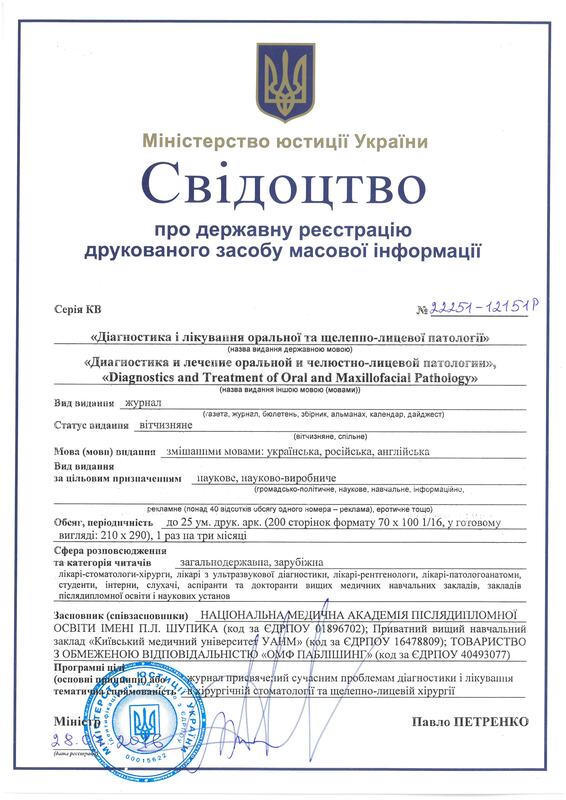
FIGURE 1. Certificate of State Registration of the Diagnostics and Treatment of Oral and Maxillofacial Pathology journal in the Ministry of Justice of Ukraine as of July 28, 2016.
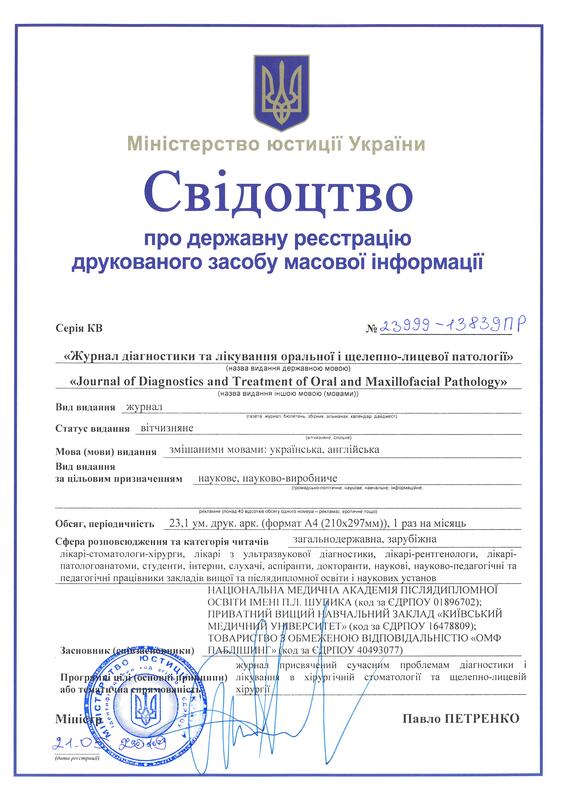
FIGURE 2. Certificate of State Re-Registration of the Journal of Diagnostics and Treatment of Oral and Maxillofacial Pathology in the Ministry of Justice of Ukraine as of May 21, 2019. The re-registration was carried out in connection with the changes in publication frequency, Journal languages (the Journal became bilingual from trilingual), and in the name of one of the co-founders, namely Kyiv Medical University, Private Higher Educational Establishment (formerly known as Kyiv Medical University of Ukrainian Association of Folk Medicine, Private Higher Educational Establishment).
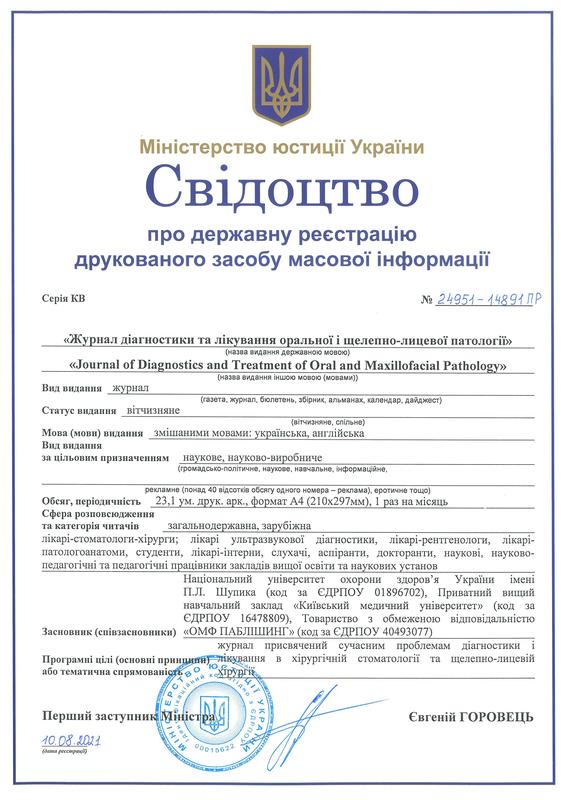
FIGURE 3. Certificate of State Re-Registration of the Journal of Diagnostics and Treatment of Oral and Maxillofacial Pathology in the Ministry of Justice of Ukraine as of August 10, 2021. The re-registration was carried out in connection with the change of name of one of the co-founders, namely Shupyk National Healthcare University of Ukraine (formerly known as Shupyk National Medical Academy of Postgraduate Education).
STATE REGISTRATION: The National Council of Television and Radio Broadcasting of Ukraine
The Journal is registered by the National Council of Television and Radio Broadcasting of Ukraine as online media (Decision of 2024, April 25, No. 1454) (download PDF). The online media identifier R40-04708 (Fig 4).
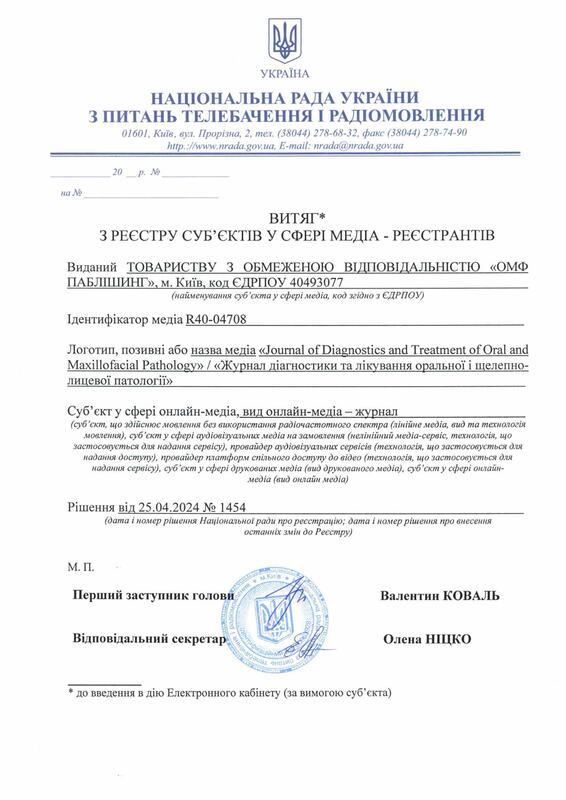
FIGURE 4. The Journal of Diagnostics and Treatment of Oral and Maxillofacial Pathology is registered by the National Council of Television and Radio Broadcasting of Ukraine as online media (Decision of 2024, April 25, No. 1454). The online media identifier R40-04708.
INTERNATIONAL STANDARD SERIAL NUMBERS (ISSNs)
-
Online (synonym: electronic) ISSN: 2522-1965 (link) (download PDF) (Fig 5).
From 2017 to 2021 (before the transition to digital-only pulication [Figs 6 and 7]) the journal also used Print ISSN: 2519-2086. ISSNs were obtained at ISSN International Center. ISSN International Center`s address: 45 rue de Turbigo, 75003 Paris, France.
All the details about the transition to online-only pulication are in the article.
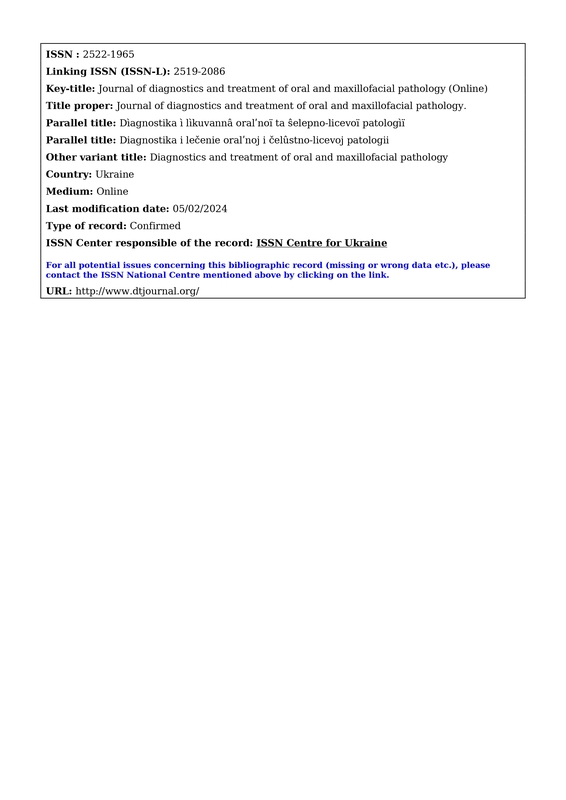
FIGURE 5. Online ISSN of the Journal of Diagnostics and Treatment of Oral and Maxillofacial Pathology.
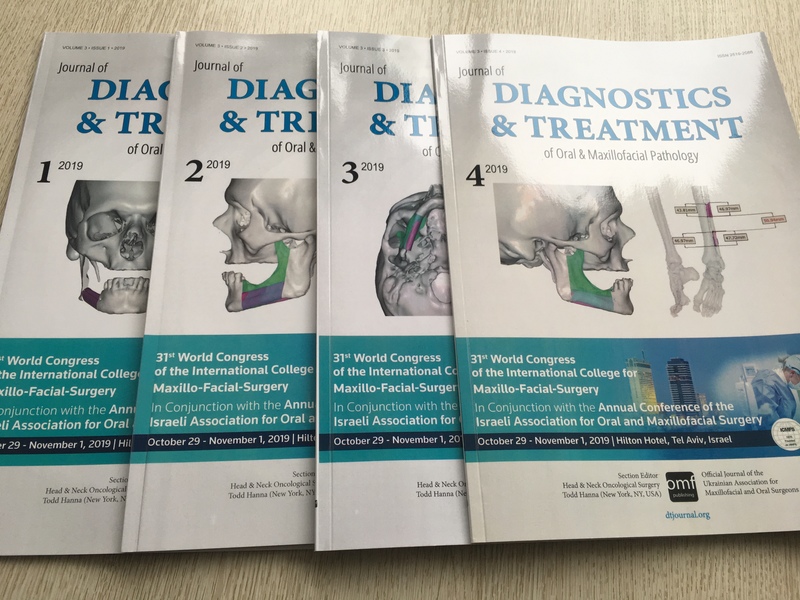
FIGURE 6. Print Issues 1-4 (Volume 3, 2019) of the Journal of Diagnostics and Treatment of Oral and Maxillofacial Pathology before the transition to digital-only pulication since January 2022. Journal cover images demonstrate virtual surgical planning for a bilateral segmental mandibular reconstruction with single fibula segmented transplants. This technique is described by Dr. Hanna and Dr. Kraus in the article (link).
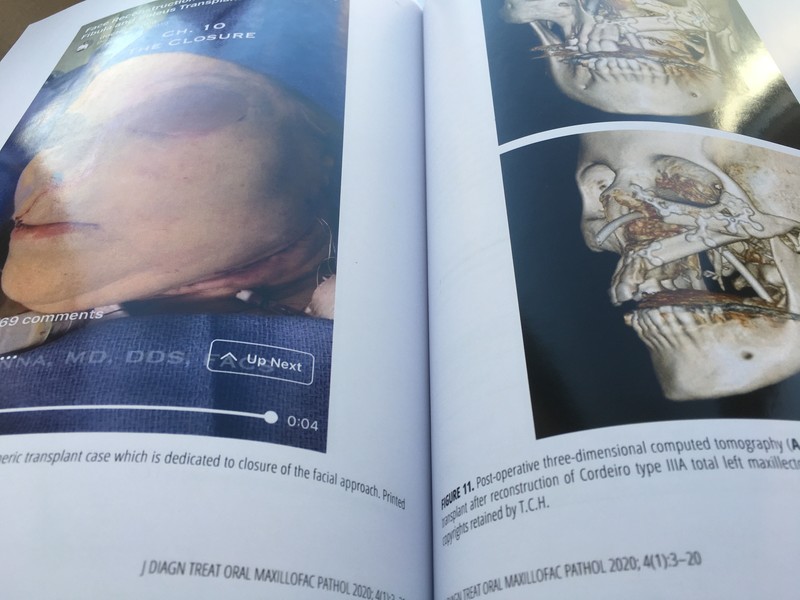
FIGURE 6. Print Issue 1 (Volume 4, 2020) of the Journal of Diagnostics and Treatment of Oral and Maxillofacial Pathology before the transition to digital-only pulication since January 2022 (read the article).
MINISTRY OF EDUCATION AND SCIENCE OF UKRAINE: Status of a Scientific Professional Publication
-
On December 28, 2017, the Journal received the status of a Scientific Professional Publication of Ukraine for the first time.
The Journal (titled in 2017 as Diagnostics and Treatment of Oral and Maxillofacial Pathology) is included in the List of Scientific Professional Publications of Ukraine, in which the results of dissertation papers can be published for obtaining degrees of Doctor and Candidate of Sciences based on the Order of the Ministry of Education and Science of Ukraine dated December 28, 2017 (Protocol No. 1714, download PDF).
PUBLICATION HISTORY
2017: 4 issues a year
2018: 4 issues a year
2019: 10 issues a year
2020 to present: 12 issues a year (i.e., monthy publication)
Repository Policy
The Journal has a policy that allows authors to place versions of their work in an institutional or other repository of their choice.
The Journal's policy regarding different versions of an article:
-
Submitted version: The journal and publisher do not allow placement in an institutional or other repository.
-
Accepted version (author-accepted manuscript): The journal and publisher allow placement in an institutional or other repository.
-
Published version (Record version): The journal and publisher allow placement in an institutional or other repository.
ABSTRACTING, INDEXING, AND archiving information
-
The journal is included to Scilit database (Basel, Switzerland).
-
The journal is included to the V. I. Vernadskyi National Library of Ukraine (link) (Kyiv, Ukraine).
-
The journal is included to Ukrainian Scientific Periodical database of the State Scientific Institution "Ukrainian Institute of Scientific and Technical Expertise and Information" (Kyiv, Ukraine). The Ukrainian Institute of Scientific and Technical Expertise and Information is a state scientific institution under the management of the Ministry of Education and Science of Ukraine.
-
Journal articles are presented in the National Repository of Academic Texts (Kyiv, Ukraine). The owner of the National Repository is the state represented by the Ministry of Education and Science of Ukraine, which determines the administrator of the National Repository and approves the regulations.
-
Journal articles are presented in the WorldCat, Ohio College Library Center (OCLS) (Dublin, Ohio, USA).
-
Journal is included in the Open Ukrainian Citation Index (OUCI). The OUCI is a search engine and a citation database that come from all publishers that use the Crossref’s Cited-by service and supports the Initiative for Open Citations. The OUCI is a project of the State Scientific and Technical Library of Ukraine.
-
Journal articles are presented in the Institutional Repository of the Kyiv Medical University, Private Higher Educational Establishment (Kyiv, Ukraine).
-
Journal in the exaly (click here). Exaly is a non-profit project to address the absence of an open and comprehensive resource of scholarly literature and scientometric data.
-
In 2023, an article about the Journal and its history was posted in the Encyclopedia of Modern Ukraine (link), published by the Institute of Encyclopedic Research of the National Academy of Sciences of Ukraine.
EDITORIAL AND PEER-REVIEW WORK-FLOW
Submission to first decision: 6 days (the median number of days from submission to first decision (desk accept or send the manuscript to review or desk reject).
Submission to decision after review: 36 days (for manuscripts that are sent to review, the median number of days from submission to receipt of first editor decision).
Submission to acceptance: 61 days (for accepted manuscripts, the median number of days from submission to receipt of accept decision).
Acceptance to online publication: 2 days (for papers published online, the median number of days from acceptance to first online publication).
ACCEPTANCE RATE
Acceptance rate in 2025 became 38 percent.
STATEMENT ON THE USE OF GENERATIVE AI
1. Scope and Purpose
This statement outlines the ethical use, disclosure, and oversight of Generative AI (GenAI) in the submission, peer review, and editorial processes of this journal. It aligns with the principles and best practices established by leading organizations in academic publishing, including the Committee on Publication Ethics (COPE) (link).
2. Definition
Generative AI refers to artificial intelligence technologies capable of producing text, images, or other content in response to user inputs. Tools such as ChatGPT, DALL-E, and similar models fall under this category.
3. Principles and Standards
3.1. Ethical Use (COPE Guidelines)
Authors, reviewers, and editors must adhere to. GenAI may assist in minor aspects of the publishing process (e.g., language editing) but must not replace human intellectual contributions or create fabricated content.
3.2. Transparency
Authors are required to disclose the use of GenAI in their manuscripts. Disclosure must explicitly state which tools were used and for what purposes.
3.3. Authorship and Accountability
GenAI tools cannot be credited as authors, as they do not meet authorship criteria: substantial intellectual contribution, drafting or revising the work, and accountability for content. Authors remain fully responsible for the accuracy, originality, and ethical compliance of their submissions, even if AI tools were used.
3.4. Peer Review Integrity
Peer reviewers using GenAI tools must disclose such use to the editorial board; AI tools may provide suggestions or summaries but cannot replace critical analysis or professional judgment required for peer review.
4. Acceptable Uses of Generative AI
Language Refinement: Authors may use GenAI for grammar correction, syntax improvements, or stylistic edits; Data Representation: AI-generated charts or images are acceptable if the data source is clearly cited and visualizations are verified; Idea Generation: AI tools can assist in brainstorming or exploring research frameworks but should not contribute original hypotheses or conclusions.
5. Prohibited Uses of Generative AI
Fabrication or Manipulation: AI must not be used to generate false data, references, or conclusions. Plagiarism: Using AI-generated content without proper attribution is a violation of ethical publishing standards. Misrepresentation: Authors must not misrepresent AI-generated work as their own intellectual contribution.
6. Disclosure Requirements
All authors must provide a clear disclosure statement regarding the use of GenAI if they used it in writing the paper. The statement should include the name(s) of the tool(s) used; specific tasks where the tool was applied (e.g., language editing, visualization).
Example Disclosure Statement: "Generative AI tools, such as ChatGPT, were used for language editing and improving the clarity of the manuscript. All intellectual content, research design, and data analysis were conducted solely by the authors."
7. Editorial Oversight
Editors will evaluate disclosed AI use during the review process to ensure it complies with this policy. Manuscripts suspected of undisclosed AI-generated content may undergo further scrutiny, including plagiarism detection tools or re-submission requests.
8. Consequences of Misuse
In alignment with COPE’s misconduct policies, violations of this policy may result in: Rejection of the manuscript; Retraction of published articles if ethical breaches are discovered post-publication; Notification to institutions, funders, or other stakeholders, where appropriate.
Examples of AI Statement in Manuscripts
Example 1. Source: RE: "How Artificial Intelligence Differs From Humans in Peer Review" (Chen, 2026). DOI:10.1016/j.joms.2025.10.008.
Declaration of Generative AI and AI-Assisted Technologies in the Writing Process
During the preparation of this work the author used Gemini in order to assist in its preparation. After using it, the author reviewed and edited the content as needed and takes full responsibility for the content of the publication.
Example 2. Source: "Internally Heated Sodium Hypochlorite for Endodontic Irrigation: A Narrative Review of Efficacy and Clinical Applicability" (Abdellatif, 2025). DOI:10.14744/eej.2025.64872.
Use of AI for Writing Assistance
The authors declared that artificial intelligence was not used in this article.
THE JOURNAL AND 16 Principles of Transparency and Best Practice in Scholarly Publishing According to Scopus®, Elsevier B.V.
The Editorial Board and Publisher supports all 16 Principles of Transparency and Best Practice in Scholarly Publishing (download PDF with the list) according to Scopus recommendations.
"A journal's website, including the text that it contains, shall demonstrate that care has been taken to ensure high ethical and professional standards. It must not contain information that might mislead readers or authors, including any attempt to mimic another journal/publisher’s site. An ‘Aims & Scope’ statement should be included on the website and the readership clearly defined. There should be a statement on what a journal will consider for publication including authorship criteria (e.g., not considering multiple submissions, redundant publications) to be included. ISSNs should be clearly displayed (separate for print and electronic)," according to Scopus® Content Selection Criteria.
The website of our journal is adapted for laptop and smartphone users. It contains such sections as: (1) About the Journal (ISSN, aims and scope, etc.) (link), (2) Editorial Board (link), (3) Ethics (link), (4) Submission (link), (5) Contacts of the Editorial Office (link), and (6) Publisher (link) pages. The website also contains sections such as the Library (link to the archive of Journal articles at the V. I. Vernadskyi National Library of Ukraine) and the Register (link to the Journal page at the Registry of Scientific Publications of Ukraine).
Name of Journal
"The Journal name shall be unique and not be one that is easily confused with another journal or that might mislead potential authors and readers about the Journal’s origin or association with other journals," according to Scopus® Content Selection Criteria.
The Journal`s name is unique and indicates how important in modern life of oral and maxillofacial surgeons both the diagnostics and treatment. Ultrasonography, computed and magnetic resonance tomography and many others imaging techniques continue to develop, more surgeons receives additional degrees in those fields. Productive collaboration of Dr. Fesenko (Managing Editor) and Dr. Ahuja (Section Editor) in the field of oral and maxillofacial and head neck ultrasound helped to attract more articles with ultrasound imaging modality than other journals focused on oral and maxillofacial surgery.
JOURNAL’S COMMON SHORT NAMES
Short title of the journal (DT Journal) indicated at the website and cover page derived from the domain name of the publication and was created with a purpose to facilitate recognition, pronunciation of the official title (Journal of Diagnostics and Treatment of Oral and Maxillofacial Pathology). Also, such short name simplifies the writing of the domain name in the browser bar.
"Journal content must be clearly marked as whether peer reviewed or not. Peer review is defined as obtaining advice on individual manuscripts from reviewers expert in the field who are not part of the journal’s editorial staff. This process, as well as any policies related to the journal’s peer review procedures, shall be clearly described on the journal website, including the method of peer review used. Journal websites should not guarantee manuscript acceptance or very short peer review times," according to Scopus® Content Selection Criteria.
The journal employs “double blind” rigorous reviewing.
Ownership and Management: Co-Founders of the Journal
"Information about the ownership and/or management of a journal shall be clearly indicated on the journal’s website. Publishers shall not use organizational or journal names that would mislead potential authors and editors about the nature of the journal’s owner," according to Scopus® Content Selection Criteria.
Three co-founders of the Journal:
-
Shupyk National Healthcare University of Ukraine (formerly known as Shupyk National Medical Academy of Postgraduate Education), Kyiv, Ukraine.
-
Kyiv Medical University, Private Higher Educational Establishment, Kyiv, Ukraine.
-
OMF Publishing, Limited Liability Company, Kyiv, Ukraine.
Shupyk National Healthcare University of Ukraine and Kyiv Medical University provide scientific support for the publication of the Journal and OMF Publishing provides publishing process, marketing, advertising, etc.
Ukrainian Association for Maxillofacial and Oral Surgeons (UAMOS) is a sponsoring society of the Journal.
Governing body and editorial team: EDITORIAL BOARD
"Information about the ownership and/or management of a journal shall be clearly indicated on the journal’s website. Publishers shall not use organizational or journal names that would mislead potential authors and editors about the nature of the journal’s owner," according to Scopus® Content Selection Criteria.
"Journals shall have editorial boards or other governing bodies whose members are recognized experts in the subject areas included within the journal’s scope. The full names and affiliations of the journal’s editorial board or other governing body shall be provided on the journal’s website," according to Scopus® Content Selection Criteria.
-
Editorial Board (EB) shows significant geographic diversity representing 38 opinion leaders representing 15 countries (Figs 8-11): Brazil, Canada, Colombia, Greece, Hong Kong (SAR, China), India, Indonesia, Israel, Italy, Slovak Republic, Spain, Ukraine, the United Arab Emirates, the United Kingdom, and the United States of America. All members of the Editorial Board have identified their affiliated institutions or organizations, along with the corresponding country or geographic region. OMF Publishing, LLC remains neutral with regard to any jurisdictional claims.
-
The majority of the editors and EB members have a discernible publication history in Scopus, Web of Science, and journals with a high impact factor.
-
The data of Editors and Editorial Board Members includes links to the ORCID, PubMed ID, Scopus ID, Web of Science ResearcherID of the author (example).
-
The publication records of all editors and EB members are consistent with the stated scope and published content of the journal.
-
The Journal have several full-time professional editors.
-
Gender distribution of the editors and EB members: 10.53% women (4 persons), 89.47% men (34 persons), 0% non-binary/other, and 0% prefer not to disclose.
-
In January 2022 was launched a unique position of Resident Ambassador (read the editorial) and Dr. Le from University of Alabama at Birmingham became the Founding Ambassador.

FIGURE 8. Professor Tymofieiev, Editor in Chief (left) and Professor Fernandes, Founding Deputy Editor in Chief (right) at 1st International Scientific Congress of the Azerbaijan Society of Oral and Maxillofacial Surgeons. 14 March, 2019; Baku, Azerbaijan.
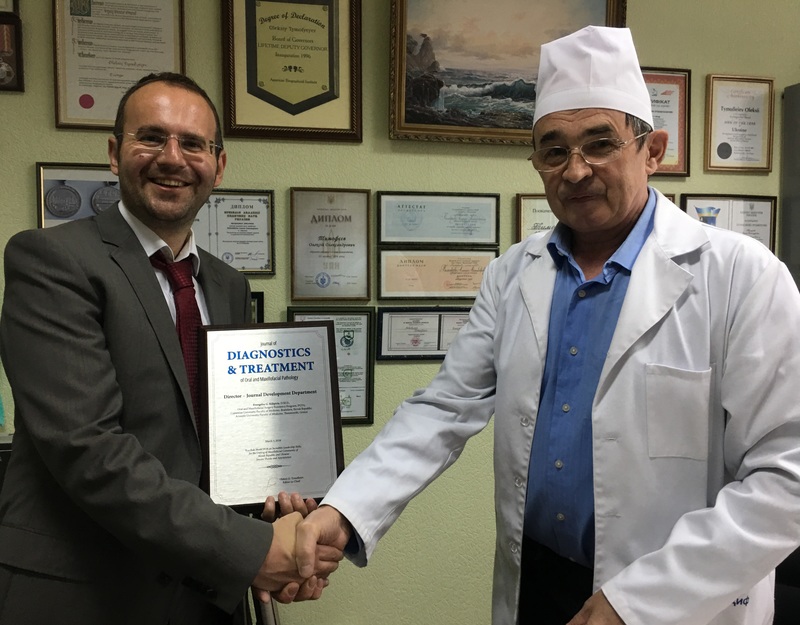
FIGURE 9. Editor in Chief Oleksii Tymofieiev (right) rewards Deputy Co-Editor in Chief Evangelos Kilipiris, DMD (left) with Journal`s Award. Kyiv, Ukraine; May, 2018. Read the article.
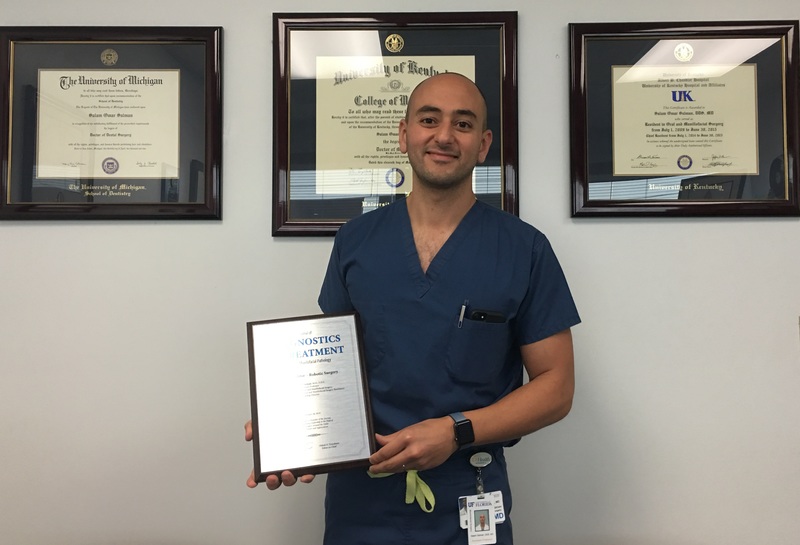
FIGURE 10. Associate Professor Salman, Section Editor with journal`s award plaque. 14 March, 2018; Jacksonville, FL, USA.
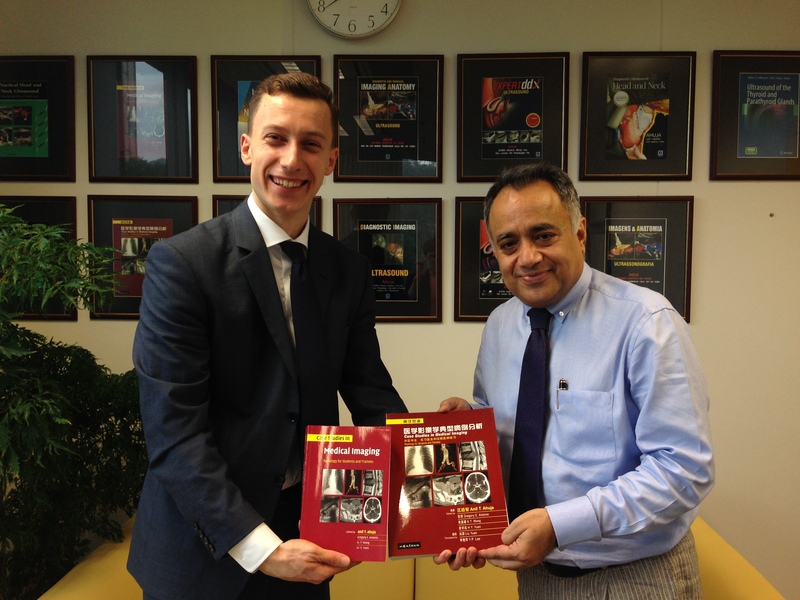
FIGURE 11. Dr. Fesenko, Managing Editor (left) and Dr. Ahuja, Section Editor (right) at the Chinese University of Hong Kong, Hong Kong, SAR, China (March 31, 2017).
Copyright and Licensing
"The policy for copyright shall be clearly stated in the author guidelines and the copyright holder named on all published articles. Likewise, licensing information shall be clearly described in guidelines on the website, and licensing terms shall be indicated on all published articles, both HTML and PDFs. If authors are allowed to publish under a Creative Commons license then any specific license requirements shall be noted. Any policies on posting of final accepted versions or published articles on third party repositories shall be clearly stated," according to Scopus® Content Selection Criteria.
By submitting a manuscript to the Journal of Diagnostics and Treatment of Oral and Maxillofacial Pathology the author(s) agrees with the placement of the published article in Open Access to the Internet on the conditions of Creative Commons Attribution-NonCommercial-ShareAlike 4.0 (CC BY-NC-SA 4.0) International (download the License to Publish in PDF and open link).
This public copyright license allows others to remix, adapt, and build upon a work, provided they follow three core conditions:
(1) Attribution (BY): You must give appropriate credit to the original creator, provide a link to the license, and indicate if changes were made.
(2) NonCommercial (NC): You may not use the material for commercial purposes, which generally means uses not primarily intended for monetary compensation or commercial advantage.
(3) ShareAlike (SA): If you remix, transform, or build upon the material, you must distribute your contributions under the same license as the original.
Key Permissions
Share: You can copy and redistribute the material in any medium or format.
Adapt: You can remix, transform, and build upon the material.
International: The 4.0 version is designed to be a single global license applicable in most jurisdictions without needing local "ports."
Comparison to Other CC Licenses
Unlike the more permissive The Creative Commons Attribution 4.0 International (CC BY 4.0), which allows for commercial use, CC BY-NC-SA 4.0 strictly prohibits it. It is more flexible than The Creative Commons Attribution-NonCommercial-NoDerivatives (CC BY-NC-ND), which prohibits any adaptations (No Derivatives).
Any fees or charges that are required for manuscript processing and/or publishing materials in the journal shall be clearly stated in a place that is easy for potential authors to find prior to submitting their manuscripts for review or explained to authors before they begin preparing their manuscript for submission. If no such fees are charged that should also be clearly stated," according to Scopus® Content Selection Criteria.
The APC (synonyms: author fee or open access publication fee) is payable by the authors or research funder to cover the costs associated with publication. This ensures your article will be immediately and permanently free to access by everyone.
The APC is 492 EUR (excluding taxes) and $246 EUR (excluding taxes) depending on the article`s type. See Submit an Article page. Moreover, the journal guarantees 100% APC waiver for sumbitted manuscripts from Ukraine which are focused on wartime and oral-maxillofacial surgery.
Process for Identification of and Dealing with Allegations of Research Misconduct
"Publishers and editors shall take reasonable steps to identify and prevent the publication of papers where research misconduct has occurred, including plagiarism, citation manipulation, and data falsification/fabrication, among others. In no case shall a journal or its editors encourage such misconduct, or knowingly allow such misconduct to take place. In the event that a journal’s publisher or editors are made aware of any allegation of research misconduct relating to a published article in their journal, the publisher or editor shall follow COPE’s guidelines (or equivalent) in dealing with allegations," according to Scopus® Content Selection Criteria.
Our team makes every effort to identify and deal with allegations of research misconduct.
Publication Ethics
"A journal shall also have policies on publishing ethics. These should be clearly visible on its website, and should refer to: i) Journal policies on authorship and contributorship; ii) How the journal will handle complaints and appeals; iii) Journal policies on conflicts of interest / competing interests; iv) Journal policies on data sharing and reproducibility; v) Journal’s policy on ethical oversight; vi) Journal’s policy on intellectual property; and vii) Journal’s options for post-publication discussions and corrections," according to Scopus® Content Selection Criteria.
All information related to pulication ethics is indicatad in the Section Ethics (link).
Publishing Schedule
"The periodicity at which a journal publishes shall be clearly indicated," according to Scopus® Content Selection Criteria.
This is a monthly publication which publishes issues at the last working day of every month.
"The way(s) in which the journal and individual articles are available to readers and whether there are associated subscription or pay per view fees shall be stated," according to Scopus® Content Selection Criteria.
Our journal is a fully open access journal what means that all articles are free to read and to download.
"A journal’s plan for electronic backup and preservation of access to the journal content (for example, access to main articles via CLOCKSS or PubMed Central) in the event a journal is no longer published shall be clearly indicated," according to Scopus® Content Selection Criteria.
The publisher performed the Journal`s electronic backup via V. I. Vernadskyi National Library of Ukraine (link), Kyiv, Ukraine.
"Business models or revenue sources (e.g., author fees, subscriptions, advertising, reprints, institutional support, and organizational support) shall be clearly stated or otherwise evident on the journal’s website. Publishing fees or waiver status should not influence editorial decision making," according to Scopus® Content Selection Criteria.
Our journal and publisher apply publishing business model typical for the “gold” open access (i.e., fully open access) peer-reviewed journals which are supported by the payment of the article publishing charge (APC) and advertising. Publishing fees or waiver status does not influence editorial decision making.
"Journals shall state their advertising policy if relevant, including what types of adverts will be considered, who makes decisions regarding accepting adverts and whether they are linked to content or reader behaviour (online only) or are displayed at random. Advertisements should not be related in any way to editorial decision making and shall be kept separate from the published content," according to Scopus® Content Selection Criteria.
Advertising policy: The adverts (surgical devices, medications, etc.) in the format of A4 design page for (1) the home page (example of image and example of that image at the home page screen) and (2) for every issue (example issue) can be considered. There are examples of A4 size advertisement pages and example of A4 size advertisement pages dedicated to medication leaflet. For advertising sales matters, contact our editorial office via email (office@omfpublishing.com).
Direct Marketing
"Any direct marketing activities, including solicitation of manuscripts that are conducted on behalf of the journal, shall be appropriate, well targeted, and unobtrusive. Information provided about the publisher or journal is expected to be truthful and not misleading for readers or authors," according to Scopus® Content Selection Criteria.
All direct marketing activities that are conducted on behalf of the journal, is appropriate, well targeted, and unobtrusive.
PUBLISHER
OMF Publishing, LLC (link) is a Ukrainian academic publishing company focused on gold open access and peer-reviewed journals.
Code of the Unified State Register of Enterprises and Organizations of Ukraine (USREOU): 40493077 (link)
Official company's name: OMF Publishing, Limited Liability Company (OMF Publishing, LLC)
Institutional sector of the economy according to the Classification of Institutional Sectors of the Economy of Ukraine (S): S.11002 Private non-financial corporation.
Address: 13-A Simferopolska Street, office 121, Kyiv 02096, Ukraine | Map
Established: March 19, 2016
Activities (Main) (also known as Industry 1):
-
58.14 Publication of journals and periodicals.
Activities (Other) (also known as Industry 2):
-
58.19 Other types of publishing activity.
-
73.12 Intermediation in the placement of advertisements in mass media.
The company received a Certificate (Fig 12) of inclusion of a publishing entity in the state register of publishers, manufacturers and distributors of publishing products. Issued by the State Committee for Television and Radio Broadcasting of Ukraine on June 29, 2016 (download PDF).
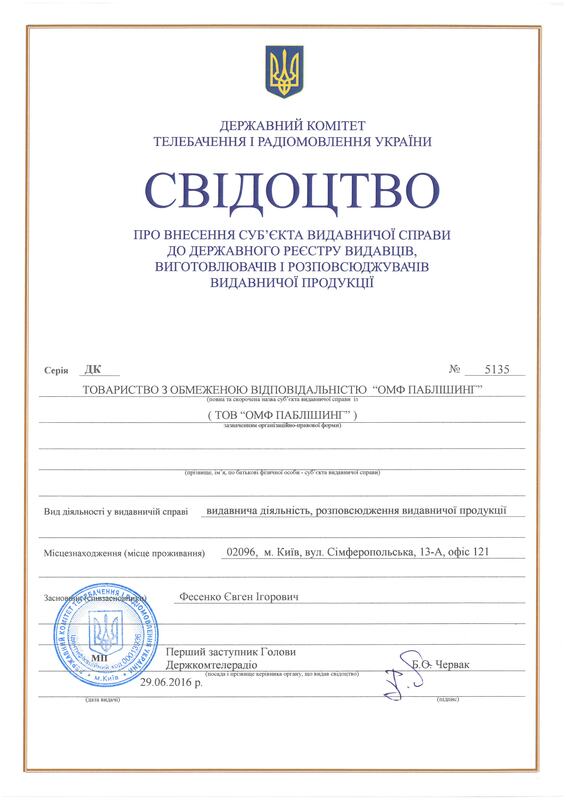
FIGURE 12. Certificate of inclusion of a publishing entity in the state register of publishers, manufacturers and distributors of publishing products issued to OMF Publishing, LLC. Series DK No. 5135. Issued by the State Committee for Television and Radio Broadcasting of Ukraine on June 29, 2016. In Ukrainian.
📧 E-mail: office@omfpublishing.com.
Website: omfpublishing.com.
Research Organization Registry (ROR) ID
CROSSREF MEMBERSHIP
OMF Publishing LLC―a Journal`s publisher―is a member of Publishers International Linking Association, Inc. which doing business as a Crossref.
OMF Publishing`s active membership: From February 2017 to present.
OMF Publishing`s obtained prefix for creating Digital Object Identifiers (DOIs): 10.23999.
Example of article with DOI: Fernandes RP, Salman SO, Quimby A. Minimally invasive techniques for management of salivary gland pathology. J Diagn Treat Oral Maxillofac Pathol 2017;1(1):11−4. https://doi.org/10.23999/j.dtomp.2017.1.2
Crossref`s headquaters address: 50 Salem Street, Lynnfield, MA 01940, United States.
JOURNAL IN SOCIAL MEDIA AND YOUTUBE
-
Our community of followers in three social networks (Instagram, Facebook, and X) unites more than 2,700 people around the globe.
-
We invites You to visit our YouTube channel (Videos of JDTOMP) which counts 25 scientific videos linked with articles.