


Published August 31, 2025
J Diagn Treat Oral Maxillofac Pathol 2025; 9: 100308.
DOI: 10.23999/j.dtomp.2025.8.100308
Under a Creative Commons license (CC BY-NC-SA 4.0)
HOW TO CITE THIS ARTICLE
Pavlenko RA, Fesenko II. Severe carbuncle of the upper lip and “the danger triangle”: A case report. J Diagn Treat Oral Maxillofac Pathol. 2025 Aug;9(8):100308. https://doi.org/10.23999/j.dtomp.2025.8.100308

INSTITUTIONAL REPOSITORY
https://ir.kmu.edu.ua/handle/123456789/829
SUMMARY
A carbuncle is an acute purulent-necrotic inflammation of two or more hair follicles, sebaceous glands, and surrounding soft tissues that can lead to severe local or general complications. Extremely severe general complications such as cavernous sinus thrombosis, meningitis, and sepsis may occur if the carbuncle is in “a danger triangle.” The purpose of this article is to highlight a 36-year-old male with an extremely severe carbuncle that had about 15 pustular openings and was located in the area of “the danger triangle.” Indeed, the anatomical areas to which the dangerous triangle extends are those where the probability of developing dangerous cranial complications is high. At the same time, we believe that “the danger triangle” does not reflect the possible septic risks from furuncles and carbuncles of the lower lip. One of the formidable complications of which can be septic necrotizing pneumonia. Early diagnosis of a carbuncle in the area of “the dangerous triangle,” correctly performed surgical and medical treatment allows to avoid dangerous local and general complications.
KEY WORDS
Furuncle, boil, carbuncle, upper lip, the danger triangle, complication
INTRODUCTION
Some sources describe boil (also known as furuncle) as a painful, bacterial infection of a hair follicle and carbuncle as cluster of furuncles that occur when the infection spreads [1]. According to other sources, a carbuncle is a purulent-necrotic inflammation of several adjacent hair follicles and sebaceous glands, which spreads to the surrounding skin and subcutaneous tissue [2, 3].
The frequency ratio of carbuncles to furuncles is 1:6 [3]. In addition to local complications of furuncles and carbuncles of the facial and temporal area, general complications such as cavernous sinus thrombosis, meningitis, and sepsis (various forms) are also possible [2, 4-8]. For example, Rueff-Barroso et al. (2023) demonstrate in their report how infection from the area of “the danger triangle” can lead to such a formidable general complication as cavernous sinus thrombosis [9].
The purpose of this article is to highlight an extremely severe carbuncle that had about 15 pustular openings and was located in the area of “the danger triangle.”
CASE REPORT
On September 07, 2011 (16:32 p.m.), a 36-year-old Caucasian male was referred to the Department of Maxillofacial Surgery and Dentistry with complaints of significant facial edema extending to the lower eyelids, upper lip pain, limited mouth opening, and extreme fewer. According to the patient, the swelling began to increase after he tried to squeeze a pimple in the upper lip area. The patient had no comorbidities.
Clinical examination revealed extreme upper lip oedema, erythema, and 15 pustular openings located in the upper lip, philtrum, and even nasal vestibule (Fig 1A). It is worth noting the location of all openings within “the danger triangle” (Fig 1B).
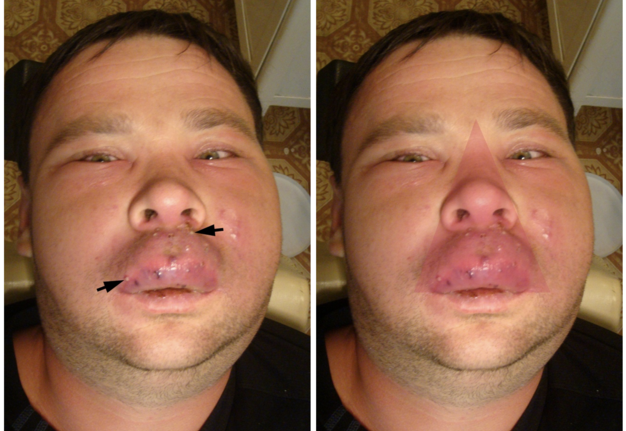
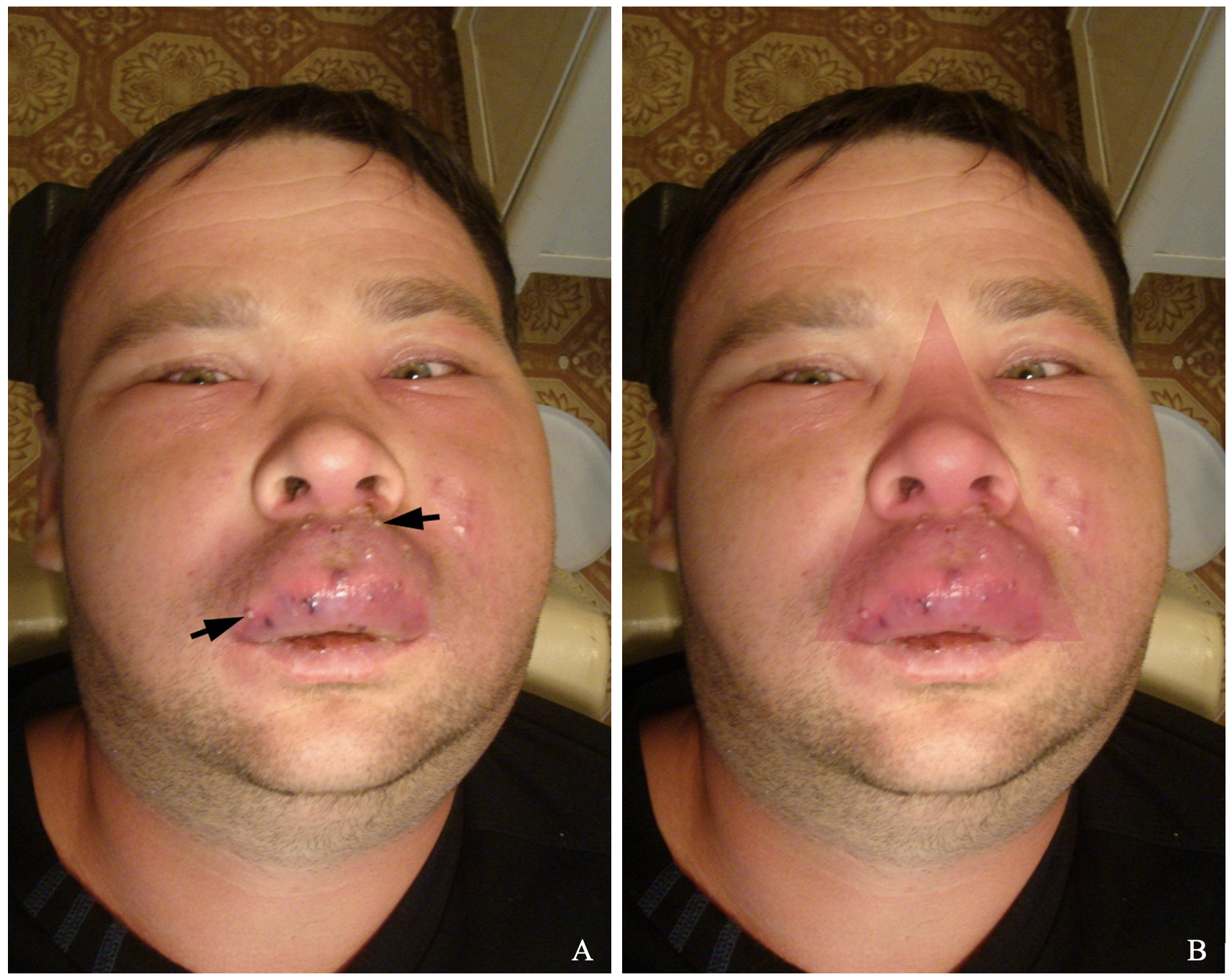
FIGURE 1. Patient appearance upon admission to hospital (A, B). Notes extreme swelling of the upper lip with numerous pustular openings (arrows). The spread of reactive edema to the infraorbital areas and lower eyelids is also noted. Image B shows “the danger triangle” (in pink).
Under bilateral infraorbital potent anesthesia (extraoral method), the carbuncle was opened and drained. Purulent passages were observed penetrating the entire thickness of the lip, reaching and exiting even into the vestibule of the nose. All spaces (passages) in which purulent content were located were drained with rubber strip drainages. After opening the carbuncle and before draining the wound, it was washed with an antiseptic solution. After opening all the passages with purulent contents, the upper lip became soft on palpation. Upon surgery, a swab from the wound was inoculated onto an appropriate medium and cultured.
Comprehensive antibacterial and detoxification therapy was prescribed using ceftriaxone and metronidazole IV. Day after day, a gradual decrease in swelling of both the lips and the under-eye areas and lower eyelids was noted, and body temperature normalized. According to the bacteriological analysis, Staphylococcus aureus was cultured. The patient was treated in the hospital for 7 days.
The wound healed with secondary tension.
DICSUSSION
If several furuncles merge, it’s called a carbuncle [12]. The condition sometimes extends widely, and fresh openings appear in the skin, and tend to coalesce with those previously formed [10]. And its treatment should be as urgent and specialized as the treatment of facial furuncles [13]. Particularly careful diagnosis and treatment of boils and carbuncles located in “the danger triangle” and infraorbital areas should be carried out [2, 3, 14, 15]. Pannu et al. (2017) describe that the danger triangle of the face consists of the area from the corners of the mouth to the bridge of the nose, including the nose and maxilla [15]. “The danger triangle of the face” is also terms as “the triangle of death” [10].
Authors emphasize that the facial veins are valveless and communicate directly with the cavernous sinus through pterygoid plexus, angular, and ophthalmic veins [15]. Zhang and Stringer (2010) claim that it is not the absence of venous valves but the existence of communications between the facial vein and cavernous sinus and the direction of blood flow that is important in the spread of infection from the face [16]. The likelihood of a severe general complication is also indicated by septic emboli originating from the upper lip infection [17]. However, we believe that “the danger triangle” does not reflect the possible septic risks from furuncles and carbuncles of the lower lip. One of the formidable complications of which can be septic necrotizing pneumonia [6].
CONCLUSION
Early diagnosis of a carbuncle in the area of “the dangerous triangle,” correctly performed surgical and medical treatment allows to avoid dangerous local and general complications.
Declaration of competing interest
The authors have no conflicts of interest to declare regarding this article.
Consent for publication
The author declares that signed informed Consent was obtained for publication of patient’s images in this article.
Generative AI statement
The author(s) declare that no Generative AI was used in the creation of this manuscript.
Acknowledgments
None.
REFERENCES (17)
-
Moore SW. B: Boils (furuncles). In: Griffith's instructions for patients. Moore SW, edition. 8th edition. Saunders, Elsevier; 2011:29-49. https://doi.org/10.1016/B978-1-4377-0909-4.50004-X
-
Tymofieiev OO. Non-odontogenic inflammatory diseases of the face. In: Maxillofacial surgery and surgical dentistry. Tymofieiev OO, editor. Volume 1. Kyiv: Medicine, All-Ukrainian Specialized Publishing House; 2020:563-588. In Russian.
-
Tymofieiev OO. Nonspecific soft tissue diseases of the maxillofacial region. In: Surgical dentistry and maxillofacial surgery. Tymofieiev OO, editor. Volume 1. Lviv: Marchenko TV; 2024:208-287. In Ukrainian.
-
Pratt GH. Furuncle of upper lip. Am J Surg. 1937;36(1):118-121. https://doi.org/10.1016/S0002-9610(37)90799-2
-
Wheeler WIdC. The danger of sepsis about the lips. Ir J Med Sci. 1926;1:369-371. https://doi.org/10.1007/BF02953980
-
Morkotun V, Tymofieiev OO, Fesenko II, et al. A lower lip infection (furuncle) complicated by abscess of the lip, suppurative cheilitis glandularis, lip necrosis, septic bilateral multilobar necrotizing (destructive) pneumonia, and pleurisy (pleuritis): a case report and literature review. J Diagn Treat Oral Maxillofac Pathol. 2023;7(9):94-114. https://doi.org/10.23999/j.dtomp.2023.9.1
-
Simha A, Suresh S, Sreeveni B, et al. Beyond the danger triangle: Septic cavernous sinus thrombosis following a temporal forehead furuncle. Trop Doct. 2025;55(3):278-280. https://doi.org/10.1177/00494755251341979
-
Cho CY, Kim KS, Kim KB. A case of cavernous sinus thrombosis due to a mistreated facial furuncle. Clin Exp Pediatr. 1999;42(4):584-588.
-
Rueff-Barroso CR, de Oliveira Mariani JF, Lumbreras EJ, et al. Clinical and anatomical aspects of cavernous sinus thrombosis associated to nasal piercing. J Morphol Sci. 2023;40:181-186. https://doi.org/10.51929/jms.40.109.2023
-
Ghosh G. Boils and carbuncles: Treatment by x-rays. Indian M Gaz. 1942;77:82-87.
-
Kim HS, Chang YJ, Chung CH. Klebsiella pneumoniae necrotizing fasciitis on the upper lip in a patient with uncontrolled diabetes. Arch Craniofac Surg. 2020;21(2):127-131. https://doi.org/10.7181/acfs.2019.00696
-
InformedHealth.org [Internet]. Cologne, Germany: Institute for Quality and Efficiency in Health Care (IQWiG); 2006-. Overview: Boils and carbuncles. [Updated 2022 Nov 22].Available from: https://www.ncbi.nlm.nih.gov/books/NBK513141/
-
Cherniak OS, Fesenko II. Periorbital abscessing furuncle. J Diagn Treat Oral Maxillofac Pathol. 2021;5(1):13-14. https://doi.org/10.23999/j.dtomp.2021.1.4
-
Amin D, Satishchandran S, Drew S, Abramowicz S. Diagnosis and treatment of lip infections. J Oral Maxillofac Surg. 2021;79(1):133-140. https://doi.org/10.1016/j.joms.2020.06.025
-
Pannu AK, Saroch A, Sharma N. Danger triangle of face and septic cavernous sinus thrombosis. J Emerg Med. 2017;53(1):137-138. https://doi.org/10.1016/j.jemermed.2017.03.016
-
Zhang J, Stringer MD. Ophthalmic and facial veins are not valveless. Clin Exp Ophthalmol. 2010;38(5):502-510. https://doi.org/10.1111/j.1442-9071.2010.02325.x
-
Jeng PY, Kao CT, Jeng JH, Yang CM. Severely swollen upper lip associated with methicillin-resistant Staphylococcus aureus infection. J Dent Sci. 2025;20(2):1328-1330. https://doi.org/10.1016/j.jds.2025.01.015